Open source projects released by SK telecom.
SK telecom members who have released open source software can register and modify the project introduction on this page by referring to the following guide.
This is the multi-page printable view of this section. Click here to print.
SK telecom members who have released open source software can register and modify the project introduction on this page by referring to the following guide.

A.X LLM is a series of Korean-specialized large language models independently developed by SK Telecom. The A.X 3.1 and A.X 4.0 series are publicly available as open source and can be freely used for academic research and commercial purposes.
| Model | Parameters | KMMLU Score | Features |
|---|---|---|---|
| A.X 4.0 Standard | 72B | 78.3 | Highest performance |
| A.X 3.1 Standard | 34B | 69.2 | Independently developed |
| A.X 4.0 Light | 7B | - | Efficiency |
| A.X 3.1 Light | - | - | Lightweight |
from transformers import AutoModelForCausalLM, AutoTokenizer

# Load A.X 4.0 Standard model
model_name = "SKT-AI/A.X-4.0-Standard"
tokenizer = AutoTokenizer.from_pretrained(model_name)
model = AutoModelForCausalLM.from_pretrained(model_name)

# Generate text
input_text = "The advancement of Korean language models"
inputs = tokenizer(input_text, return_tensors="pt")
outputs = model.generate(inputs, max_length=100)
print(tokenizer.decode(outputs[0]))

KoBERT is a Korean-specialized BERT model developed by SK Telecom to overcome the limitations of Google’s publicly released BERT language model in processing Korean.
pip install kobert-transformers
pip install transformers
from kobert_transformers import get_tokenizer
from transformers import BertModel

# Load tokenizer and model
tokenizer = get_tokenizer()
model = BertModel.from_pretrained('skt/kobert-base-v1')

# Tokenize and generate embeddings
text = "Korean natural language processing is fascinating"
inputs = tokenizer(text, return_tensors='pt')
outputs = model(inputs)

# Extract sentence embedding
sentence_embedding = outputs.last_hidden_state[:, 0, :].squeeze()
print(sentence_embedding.shape)  # torch.Size([768])
import torch
from kobert_transformers import get_kobert_model, get_tokenizer

# Load model and tokenizer
tokenizer = get_tokenizer()
model = get_kobert_model()

# Process text
text = "KoBERT is specialized in Korean language understanding."
encoded = tokenizer.encode_plus(
    text,
    add_special_tokens=True,
    max_length=128,
    padding='max_length',
    return_attention_mask=True,
    return_tensors='pt'
)

# Model inference
with torch.no_grad():
    outputs = model(
        input_ids=encoded['input_ids'],
        attention_mask=encoded['attention_mask']
    )

pooled_output = outputs[1]  # [CLS] token output
print(pooled_output.shape)  # torch.Size([1, 768])
| Task | Dataset | KoBERT Score | Baseline |
|---|---|---|---|
| Sentiment Analysis | NSMC | 89.63% | 87.42% |
| NER | Korean NER | 86.11% | 84.13% |
| Sentence Similarity | KorSTS | 81.59% | 77.92% |
| Question Answering | KorQuAD 1.0 | 52.81 (EM) | 48.42 |
from transformers import AutoModel, AutoTokenizer

# Load directly from Hugging Face Hub
model_name = "skt/kobert-base-v1"
tokenizer = AutoTokenizer.from_pretrained(model_name)
model = AutoModel.from_pretrained(model_name)

# Inference
text = "KoBERT is the standard for Korean natural language processing"
inputs = tokenizer(text, return_tensors="pt")
outputs = model(inputs)
Apache License 2.0 - Commercial use allowed
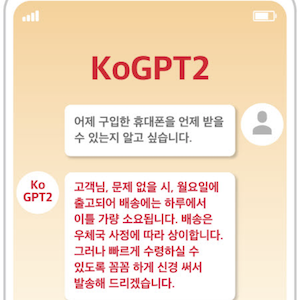
KoGPT2 is an open-source based GPT-2 model trained on Korean language. By optimizing OpenAI’s GPT-2 architecture for Korean, it can be used in various applications requiring Korean language understanding such as text generation, sentence completion, and chatbots.
pip install kogpt2-transformers
import torch
from transformers import GPT2LMHeadModel
from kogpt2_transformers import get_kogpt2_tokenizer

# Load model and tokenizer
tokenizer = get_kogpt2_tokenizer()
model = GPT2LMHeadModel.from_pretrained('skt/kogpt2-base-v2')

# Text generation
text = "The future of artificial intelligence is"
input_ids = tokenizer.encode(text, return_tensors='pt')

# Set generation parameters
gen_ids = model.generate(
    input_ids,
    max_length=128,
    repetition_penalty=2.0,
    pad_token_id=tokenizer.pad_token_id,
    eos_token_id=tokenizer.eos_token_id,
    bos_token_id=tokenizer.bos_token_id,
    use_cache=True
)

# Decode results
generated = tokenizer.decode(gen_ids[0])
print(generated)
from transformers import pipeline

# Text generation pipeline
generator = pipeline(
    'text-generation',
    model='skt/kogpt2-base-v2',
    tokenizer='skt/kogpt2-base-v2'
)

# Generate text
prompt = "Korean natural language processing technology"
result = generator(
    prompt,
    max_length=100,
    num_return_sequences=3,
    temperature=0.8
)

for i, text in enumerate(result):
    print(f"Result {i+1}: {text['generated_text']}")
from kogpt2_transformers import get_kogpt2_tokenizer
from transformers import GPT2LMHeadModel
import torch

tokenizer = get_kogpt2_tokenizer()
model = GPT2LMHeadModel.from_pretrained('skt/kogpt2-base-v2')

# Reviews for sentiment analysis
reviews = [
    "This movie was really fun",
    "The service was terrible",
    "Great product for the price"
]

for review in reviews:
    # Prompt engineering for positive/negative judgment
    prompt = f"{review} This review is"
    input_ids = tokenizer.encode(prompt, return_tensors='pt')

    with torch.no_grad():
        output = model.generate(
            input_ids,
            max_length=len(input_ids[0]) + 10,
            num_return_sequences=1,
            temperature=0.7
        )

    result = tokenizer.decode(output[0])
    print(f"Original: {review}")
    print(f"Analysis: {result}\n")
from kogpt2_transformers import get_kogpt2_tokenizer
from transformers import GPT2LMHeadModel
import torch

tokenizer = get_kogpt2_tokenizer()
model = GPT2LMHeadModel.from_pretrained('skt/kogpt2-base-v2')

def generate_response(user_input, context=""):
    """Generate conversation-based response"""
    prompt = f"{context}\nUser: {user_input}\nAI:"

    input_ids = tokenizer.encode(prompt, return_tensors='pt')

    with torch.no_grad():
        output = model.generate(
            input_ids,
            max_length=input_ids.shape[1] + 50,
            temperature=0.8,
            top_k=50,
            top_p=0.95,
            repetition_penalty=1.2,
            do_sample=True
        )

    response = tokenizer.decode(output[0], skip_special_tokens=True)
    # Extract only the AI response part
    ai_response = response.split("AI:")[-1].strip()

    return ai_response

# Chatbot conversation example
context = ""
while True:
    user_input = input("You: ")
    if user_input.lower() in ['quit', 'exit']:
        break

    response = generate_response(user_input, context)
    print(f"AI: {response}\n")

    # Update context
    context += f"User: {user_input}\nAI: {response}\n"
| Task | Dataset | KoGPT2 Score |
|---|---|---|
| Text generation quality | Human evaluation | 4.2/5.0 |
| Sentence completion | Self-evaluation | 85% |
| Conversation naturalness | Self-evaluation | 78% |
CC-BY-NC-ND 4.0 - Non-commercial use, modification and redistribution allowed
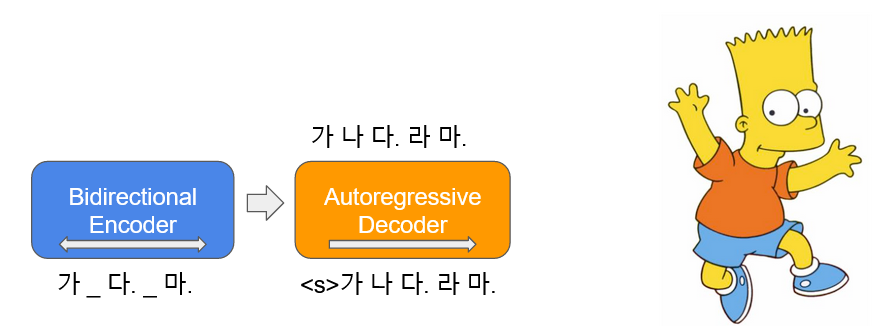
KoBART is a BART (Bidirectional and Auto-Regressive Transformers) model specialized in Korean text generation and summarization. Utilizing an Encoder-Decoder architecture, it demonstrates excellent performance across various natural language generation tasks.
pip install transformers torch
from transformers import PreTrainedTokenizerFast, BartForConditionalGeneration

# Load model and tokenizer
tokenizer = PreTrainedTokenizerFast.from_pretrained('gogamza/kobart-base-v2')
model = BartForConditionalGeneration.from_pretrained('gogamza/kobart-base-v2')

# Summarize long text
text = """
SK Telecom is Korea's leading mobile telecommunications company with
extensive ICT technology including AI, 5G, and cloud services. Recently,
it developed the Korean large language model A.X and released it as
open source, contributing to the development of the domestic AI ecosystem.
"""

# Encode and generate summary
inputs = tokenizer(text, return_tensors='pt', max_length=1024, truncation=True)
summary_ids = model.generate(
    inputs['input_ids'],
    max_length=150,
    num_beams=5,
    early_stopping=True
)

# Decode
summary = tokenizer.decode(summary_ids[0], skip_special_tokens=True)
print(summary)
# Prompt-based text generation
prompt = "With the advancement of artificial intelligence"

inputs = tokenizer(prompt, return_tensors='pt')
outputs = model.generate(
    inputs['input_ids'],
    max_length=100,
    temperature=0.8,
    do_sample=True,
    top_k=50
)

generated_text = tokenizer.decode(outputs[0], skip_special_tokens=True)
print(generated_text)
from transformers import Trainer, TrainingArguments

# Fine-tuning configuration
training_args = TrainingArguments(
    output_dir='./kobart-finetuned',
    num_train_epochs=3,
    per_device_train_batch_size=8,
    per_device_eval_batch_size=8,
    warmup_steps=500,
    weight_decay=0.01,
    logging_dir='./logs',
    evaluation_strategy="epoch"
)

# Create Trainer
trainer = Trainer(
    model=model,
    args=training_args,
    train_dataset=train_dataset,
    eval_dataset=eval_dataset
)

# Start training
trainer.train()
onot is a compliance tool that automatically generates open source license notices based on SPDX (Software Package Data Exchange) documents. It was jointly developed by SK Telecom and Kakao and released as open source.
# Install from PyPI
pip install onot

# Or install from source
git clone https://github.com/sktelecom/onot.git
cd onot
pip install -e .
# Generate HTML license notice from SPDX file
onot -i sbom.spdx.json -o notice.html

# Generate in Markdown format
onot -i sbom.spdx.json -o notice.md -f markdown

# Generate in Excel format
onot -i sbom.spdx.json -o notice.xlsx -f excel
{
  "spdxVersion": "SPDX-2.3",
  "dataLicense": "CC0-1.0",
  "SPDXID": "SPDXRef-DOCUMENT",
  "name": "MyProject",
  "packages": [
    {
      "SPDXID": "SPDXRef-Package-1",
      "name": "express",
      "versionInfo": "4.18.2",
      "licenseConcluded": "MIT",
      "copyrightText": "Copyright (c) 2009-2014 TJ Holowaychuk",
      "downloadLocation": "https://registry.npmjs.org/express/-/express-4.18.2.tgz"
    }
  ]
}
Apache License 2.0 - Commercial use allowed
SKT Passkey is a passwordless authentication solution based on the WebAuthn (FIDO2) standard. It provides safe and convenient login experience using biometric recognition or device PIN, and can be integrated with SK Telecom’s Passkey Platform to build enterprise-grade reliable authentication systems.

Passkey is a safe and convenient authentication method that replaces traditional passwords:
Authenticator: Device that performs authentication
Relying Party (RP): Your application that uses Passkey
Passkey Platform: SK Telecom’s authentication service
1. User Registration
   ├─ Generate credential pair (public/private key)
   ├─ Store public key in server
   └─ Store private key in device

2. Authentication
   ├─ User initiates login
   ├─ Server sends challenge
   ├─ Device signs challenge with private key
   ├─ Server verifies signature with public key
   └─ User authenticated
Apache License 2.0 - Commercial use allowed