AI SBOM and Regulation
An AI SBOM is a machine-readable inventory of a model, its training datasets, and their provenance and licenses.
- Where a software SBOM carries package dependencies, an AI SBOM also covers what a software SBOM leaves out: model weights and training data.
- It is built from what the model card says, so a thin model card leaves an AI SBOM with that many empty entries.
Why produce one
It serves two purposes.
- For the publisher it is a self-check on how complete the documentation is. Seeing what is missing as a list means you can close the gaps before release.
- For the recipient it is evidence for a review. Just as SK Telecom asks suppliers for an SBOM, other organizations have begun asking the same of AI models.
Key regulations
Nothing on this page certifies or determines compliance with any regulation.
- It makes documentation gaps visible so a person can prepare.
- Interpreting them against a specific system’s legal obligations is a person’s job; when in doubt, consult Legal and the OSRB.
| Regulation | Applies to | Applicable from | Key provisions |
|---|---|---|---|
| EU AI Act | Releasing a model that can serve general purposes | 2 August 2025 | Article 53 |
| EU AI Act | A model that ends up in a high-risk system | 2 December 2027 | Article 11, Annex IV |
| Korea’s AI Framework Act | Affecting the Korean market or its users | In effect since 22 January 2026 | Article 31 (transparency), 32 (safety), 33–34 (high-impact AI), 35 (impact assessment) |
- What reaches you when you release a general-purpose model is Article 53. It asks for technical documentation, a copyright policy, and a public summary of training content, and it already applies.
- Fine-tuning someone else’s base model may leave you outside those duties. The Commission’s guidelines use a third of the original training compute as the dividing line.
- Releasing the weights and the architecture under an open-source licence exempts the technical documentation, but the copyright policy and the public summary of training content remain. The summary follows a template the Commission provides.
- Article 11 and Annex IV attach to the high-risk system your model ends up in, not to the model.
- Korea’s AI Framework Act keeps its detailed documentation requirements in the enforcement decree, so it is less specific than the EU’s. Article 32 (safety) applies only to systems trained above a compute threshold set by that decree, so a linked element points at the subject of the duty rather than establishing that the duty applies.
The G7 minimum elements
In May 2026, the cybersecurity agencies of the G7 jointly published “Software Bill of Materials for AI — Minimum Elements”, with Germany’s BSI and Italy’s ACN leading the work. It defines 50 minimum elements in seven clusters that an AI system’s inventory should carry. It is a non-binding recommendation, not a regulation.
| Cluster | Elements | Needing human judgement | Content |
|---|---|---|---|
| Metadata | 10 | 0 | Who produced the inventory, when, with which tool |
| System-level properties | 9 | 4 | System name, application area, data flow |
| Models | 13 | 0 | Model identifier, license, integrity, training properties |
| Dataset properties | 10 | 5 | Dataset provenance, statistics, sensitivity, license |
| Infrastructure | 2 | 0 | Software dependencies and hardware |
| Security properties | 4 | 3 | Security controls, policy, vulnerability handling |
| Key performance indicators | 2 | 1 | Security metrics and operational performance |
| Total | 50 | 13 |
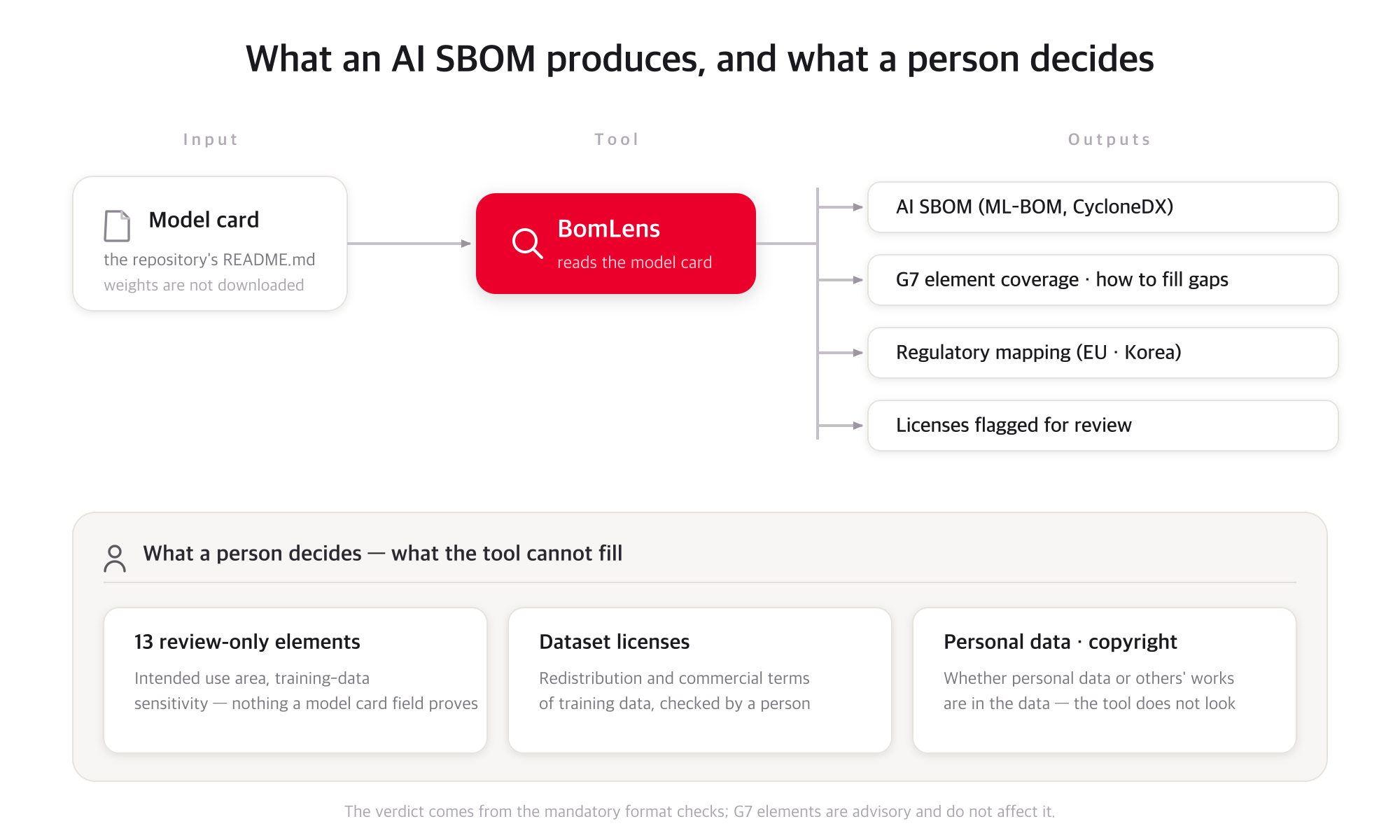
- Thirteen of the 50 have no automated source. Things like the intended application area or the sensitivity of the training data cannot be proven by any model card field, so a person has to supply them.
- BomLens reports these 50 as 51 checks, because it scores model openness on its own line.
- The technical documentation the EU AI Act asks for corresponds to the G7 system-level, model, and dataset clusters. That correspondence is BomLens’s reading.
- Advisory as they are, the elements overlap substantially with the documentation those regulations require. Filling the G7 side also builds most of what a regulatory submission needs.
Producing an AI SBOM
Give BomLens, SK Telecom’s open-source SBOM generator, a model id and it reads the model card, builds a CycloneDX AI SBOM, and reports G7 element coverage alongside the regulatory mapping. (It reads the model card and the repository metadata; it does not download the weight files themselves.)
- Setup, usage and how to read the reports are covered in the BomLens AI model guide.
- It needs a Docker engine, and pulls the AI-model scanning image (about 3.5 GB) once.
- The command below assumes BomLens is already installed.
./scripts/scan-sbom.sh --project my-llm --version 1.0.0 \
  --model "my-org/my-llm" --generate-only
A private repository needs a token with read access.
- Create a read-scoped token under Access Tokens in your Hugging Face account settings. A fine-grained token needs read access to that repository granted explicitly.
- How to pass it as
HF_TOKEN, and what a gated repository additionally requires, are in Private and gated models.
You get:
- an AI SBOM covering the model and its datasets
- per-element coverage, and how to supply what is missing
- the mapping to the EU AI Act and Korea’s AI Framework Act
- components whose license needs human review
Checking the result
An overall pass does not mean every G7 element is filled. G7 elements are all advisory and do not move the verdict. Read the covered count and the gap count separately.
- Gaps come in two kinds: those you close by writing in the model card, and those a person has to judge. Start with the first kind.
- To see what a report looks like before running anything, open the conformance report from a sample model scan. It opens with coverage per cluster and the licences flagged for review, then works down to the per-check verdicts.
Related pages
- Model card — the input to an AI SBOM
- Pre-release checklist — what to confirm before release
- What is an SBOM — SBOMs in general
- BomLens AI model guide — setup, usage, reading the reports
- BomLens — the tool, and its supplier-facing usage
References
- Software Bill of Materials for AI — Minimum Elements (G7, May 2026)
- Regulation (EU) 2024/1689 (AI Act)
- Timeline for the implementation of the EU AI Act (European Commission)
- AI Framework Act (Korea)
Contact
For questions about producing or reading an AI SBOM, contact the OSRB (opensource@sktelecom.com).
Feedback
Was this page helpful?
Glad to hear it! Please tell us how we can improve.
Sorry to hear that. Please tell us how we can improve.